Validators embrace XRP Ledger’s recent upgrade. But not everyone’s on board yet

The XRP Ledger’s recent server software upgrade, v3.2.0, designed to make the network cheaper to run, more stable, and more attractive for institutional use, is gaining adoption. However, it has yet to overtake the previous version (3.1.3) across the wider network, and the key security fixes that come with it remain in the voting process.

Of the approximately 833 active nodes on the XRP Ledger, the machines that store and relay the ledger, about 43% are running v3.2.0 and 51% are still on v3.1.3, XRPSCAN data shows.

The software rolled out on June 15.

(XRPScan)

While overall node adoption appears relatively slow, validators, or entities that matter most to the network, have largely already upgraded.

The XRP Ledger runs on a trusted set of validators known as the Unique Node List (UNL). For a new software version or amendment to activate, it needs sustained support from more than 80% of validators on that list for two straight weeks.

On the default UNL of 35 validators, 31 are running v3.2.0, about 89%, clearing the threshold the network treats as sufficiently updated. That figure, not the raw node or all-validator percentages, is what determines whether the upgrade completes.

The amendment lagging behind

An amendment called fixCleanup3_2_0 is currently under voting. Unlike a regular software upgrade, this is a formal on-ledger vote. It bundles several security fixes and improvements for the network’s newer features, including single-asset vaults, permissioned decentralized exchanges, multi-purpose tokens (MPTs) and the lending protocol. The lending protocol is the on-chain lending system CoinDesk covered last month that lets users take out loans against pooled funds.

It also adds internal checks designed to prevent deleted accounts from leaving behind stray data. That amendment is polling far lower than the software adoption, however, so upgrading a validator and voting the amendment through are two distinct steps.

Ripple, the payments company whose founders created the XRP Ledger, has voted in favor of the fixCleanup3_2_0 amendment. Validators that fail to upgrade before the amendment activates risk being cut off from the ledger in what the ledger calls an amendment-blocked state.

(0)
Ethereum’s newest nonprofit wants to become Wall Street’s guide to crypto

Ethereum’s newest nonprofit is positioning itself asWall Street’s crypto sherpa, guiding banks and asset managers through the Ethereum ecosystem at a pivotal moment for the network.

For much of the past year, the conversation around Ethereum has been dominated by questions about its future. The Ethereum Foundation has faced mounting criticism over its role in the ecosystem, and, in response, has restructured its leadershiplaid off staff and narrowed its focus to stewarding the protocol. At the same time, independent organizations have begun emerging to take on responsibilities that were once housed within the foundation.

The latest is Ethereum Institutional, a nonprofit launched last week with an ambitious goal: becoming the Ethereum ecosystem’s front door for banks, asset managers and other financial institutions.

Its founders say the organization will serve as a neutral guide for enterprises exploring Ethereum, helping institutions understand the ecosystem, connect with developers and infrastructure providers, and navigate the network without promoting any single company or product.

Ethereum Institutional is led by David Walsh, Matthew Dawson and Marius Smith, whose backgrounds span traditional finance, technology and crypto. Walsh and Dawson previously worked on the Ethereum Foundation’s enterprise engagement team, while Smith joined after senior roles at Google and EigenLayer developer Eigen Labs.

“We’ve built up around 500 relationships over the course of the year, and what’s consistently come back was that they appreciate having a neutral counterpart,” Dawson told CoinDesk in an interview. “There’s thousands of teams in the Ethereum ecosystem… the feedback sometimes has been, ‘This is overwhelming.'”

The organization is designed to fill what its founders see as a missing piece in Ethereum’s institutional strategy.

Unlike companies building products on Ethereum, Ethereum Institutional says it will work across the ecosystem, helping enterprises evaluate use cases such as tokenization, stablecoins and digital asset infrastructure while introducing them to the teams best suited for their needs.

“Navigating what is already a new and fairly complex technology and the decentralized ecosystem is a bit daunting,” Dawson said. “Having a trusted and neutral partner that can help with that navigation… can accelerate that journey and give them confidence.”

Its launch comes as Ethereum itself reaches an inflection point. The leaders steering the network are increasingly formalizing how different parts of the ecosystem are taking on responsibilities and roles. The Ethereum Foundation has made clear it intends to focus more narrowly on protocol development while encouraging independent organizations to lead areas such as business development, ecosystem growth and institutional engagement.

For Ethereum Institutional’s founders, becoming an independent nonprofit rather than remaining within the foundation was a deliberate choice.

“The EF has always been quite vocal about its principle of subtraction,” Dawson said, referring to the organization diving up responsibilities for the network to other organizations . “This is an example of that increasing decentralization, and the number of nodes participating in representing Ethereum.”

Operating outside the foundation also gives the organization greater freedom, Walsh said.

“We feel like we have a lot more autonomy and freedom to work as an independent entity,” he said. “We can get a bit more opinionated, and a bit more aggressive, in terms of being able to support these teams.”

For years, the Ethereum Foundation has walked a careful line in how much influence it exerts over the ecosystem. Its mandate has largely been to coordinate protocol development and steward Ethereum’s technical roadmap, rather than act as a central authority driving business development or adoption. But as the network grew, some in the community pushed for the foundation to take on a more active role in areas like institutional outreach and ecosystem coordination, responsibilities it has increasingly chosen to decentralize instead.

Ethereum Institutional joins a growing network of organizations taking on specialized roles within Ethereum. Last month, EthLabs launched to support ecosystem development, while firms such as Etherealize, launched in 2025, have focused on bringing institutions onchain through commercial products and services.

Walsh sees Ethereum Institutional as complementary to these other firms rather than competitive. “We’ve taken a slightly different approach, where it’s a bit more about education and a bit more neutral in terms of what solutions we want to help institutions adopt.”

The founders argue that while much of the online conversation around Ethereum has focused on governance debates and competition from rival blockchains, institutional momentum has continued to build behind the scenes.

He points to recent tokenization initiatives from firms including BlackRockJPMorgan and Robinhood as evidence that Ethereum remains the dominant platform for institutional blockchain deployments.

For Dawson, there’s no contradiction between Ethereum’s cypherpunk origins and Wall Street’s growing interest, even as many feel like those interests may be separating.

“Those cypherpunk values translate into operational resilience for institutions,” he said. “Lack of downtime and security are all things that institutions are absolutely obsessed with.”

The founders don’t believe Ethereum’s future belongs solely to banks. Instead, they see institutional adoption as one piece of a much broader vision.

“I think of it as the internet,” Walsh said. “There’s room for everyone: DeFi, cross-border payments, banking the unbanked, and Wall Street.”

Read more: EthLabs launches as Ethereum undergoes its biggest leadership transition in years

(0)
Bitcoin drops after a run at $64,000, shrugging off Strategy’s $213 million BTC sale

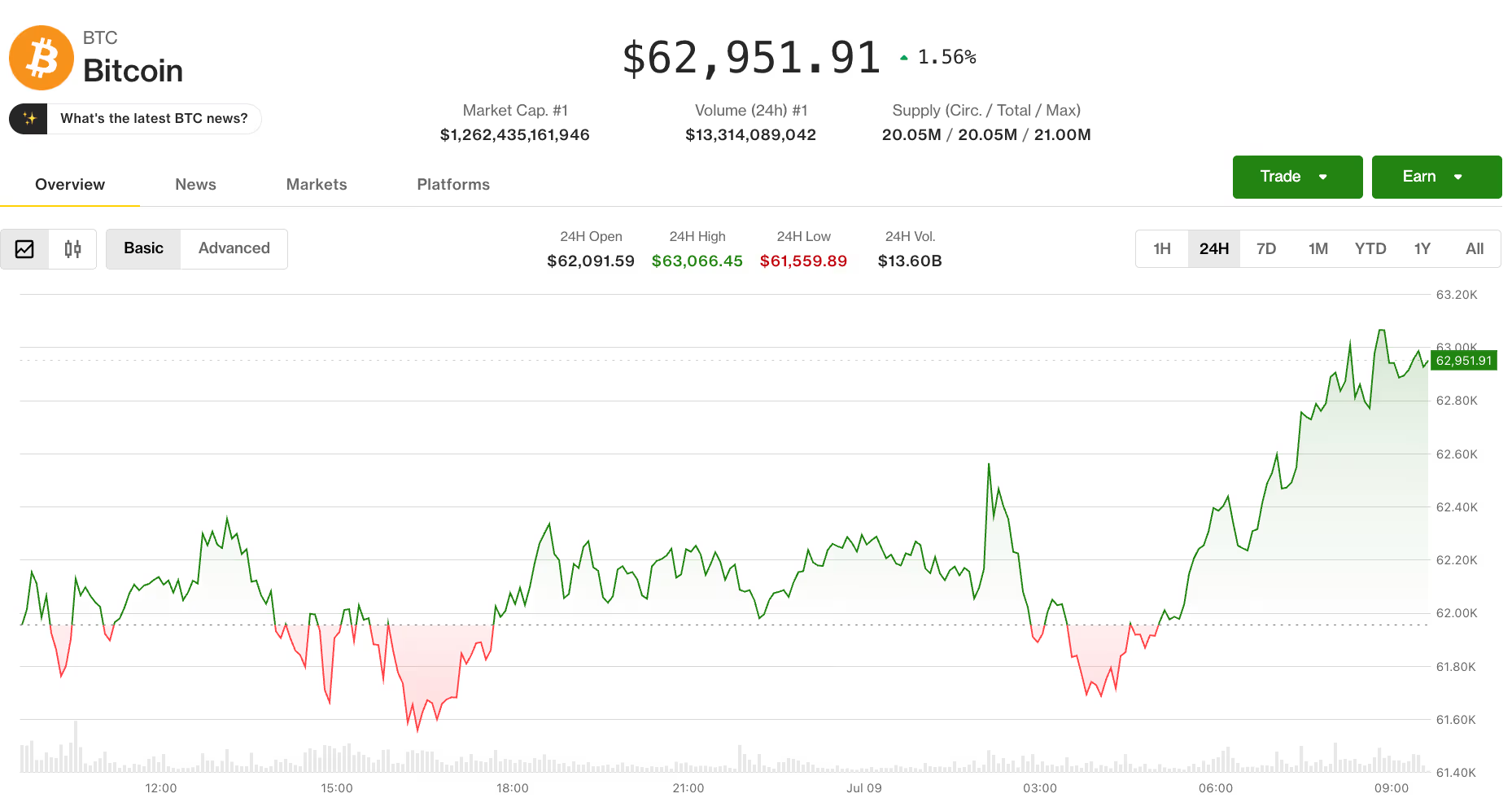
Bitcoin held in the low $63,000s on Tuesday after an overnight push above $64,000 faded, a round trip that left the token roughly flat on the day but still up about 6% over the week.

Bitcoin traded around $63,170, per CoinDesk data, after touching $64,400 in the early hours and slipping back. The move came despite Strategy’s disclosure this week that it sold 3,588 bitcoin for about $216 million, its largest sale since abandoning its never-sell stance, which the market largely absorbed without breaking the recovery.

Ether held near $1,770, up 11.6% on the week, while XRP and solana kept most of their weekly gains at $1.13 and $80. Most majors were little changed on the day after leading the prior week’s advance.

The recovery has firmed even as its footing stays thin. Bitcoin fell to a 21-month low near $58,000 at the end of June and has clawed back into the low $60,000s, a bounce rather than a breakdown after a first half it closed down about 20%, with its first weekly close below the 200-week moving average, a long-term trend line, since 2023.

Some derivatives traders read the washout as late-stage rather than early.

“The institutional bid has all but vanished,” said Yusuf Fakhro, partner at ARP Digital, pointing to CME futures open interest at a 32-month low and a term structure at its tightest since early 2023.

He added that six-month options skew, a measure of how much traders pay to protect against a drop, has spiked to its fourth-highest on record, with the only parallels in June and November 2022, both of which came near major cycle bottoms.

When downside insurance gets this expensive, he said, the market is paying up for protection just as the worst may already be priced in.

Oil re-entered the picture overnight. Brent crude rose 0.6% to about $72.45 a barrel after a laden liquefied natural gas carrier was struck by a projectile near the Omani coast as it left the Strait of Hormuz, according to Bloomberg, a fresh attack that tests the peace deal reached in late June.

Energy shocks tied to the Iran conflict drove crypto’s selling earlier this year before the truce eased them, and a renewed flare-up is the kind of macro risk that had faded from the market’s view.

Elsewhere, Asian shares fell as technology stocks came under renewed selling, with South Korea’s Kospi down 6.7%, according to Bloomberg. Samsung Electronics slid 8.3% even after quarterly profit surged, and SK Hynix fell the same as it began marketing a U.S. listing. U.S. futures pointed lower, suggesting Monday’s Wall Street rebound may not carry.

For most of the year, weakness in AI and chip stocks pulled crypto markets down with it, and this week the two have moved apart, with bitcoin steady as equities slid.

Whether that independence lasts, and whether the ETF inflows build, will decide if the bounce off $58,000 becomes a base or fades. The renewed oil risk out of Hormuz is the new variable – a reminder that the macro backdrop that battered crypto in the first half has not fully cleared.

(0)
Bitcoin’s dwindling exchange reserves don’t pack the same bullish punch anymore

One of bitcoin’s BTC$62,985.21 oldest and most enduring bullish signals is still making the rounds on social media even though it no longer carries the weight it once did.

For years, interpreting the amount of BTC held in wallets controlled by centralized exchanges has been straightforward. A declining balance means investors are withdrawing coins to self-custody. Fewer coins available for sale on exchanges should, in theory, reduce selling pressure and support prices. This read has been treated as reliably bullish since bitcoin’s early days and the narrative persists today, according to blockchain analytics firm Santiment.

“Historically, sustained drawdowns in exchange supply have preceded multi-quarter bull phases.” Mark Zalan, the CEO of GoMining, the world’s largest tokenized retail mining platform, said in an interview. He declined, however, to put a date on when the bull cycle will begin. “Anyone who tells a journalist they know the exact turn is guessing with confidence, not forecasting.”

The metric, however, no longer carries the weight that it used to, not least because supply has been low for months even as bitcoin has languished at around 50% of its peak value. The interpretation is outdated, some industry observers say, because it does not account for the rise in institutional custody. The financialization of bitcoin through alternative investment vehicles has changed the market in ways that make the indicator unreliable.

“People always used to look at low exchange supply as a clear bullish sign,” said Eneko Knorr, CEO of Stabolut, a multicurrency, yield-bearing stablecoin platform. “We’ve had this super-low supply for over a year now. The market grew up, and a lot of that crypto just moved somewhere else – like staking, DeFi protocols to earn some yield, or big institutional vaults.”

Santiment noted on X that the supply of BTC and ether (ETH) on exchanges has dropped to the lowest since 2017 and 2015, respectively, calling it one of the crypto’s “most encouraging signals for the long term.” According to Santiment’s chart, bitcoin’s exchange supply sits at 6.6% of its total circulating supply and ether’s at 4.3%.

“Bitcoin and ethereum are showing one of crypto’s most encouraging signals for the long term: coins are staying off exchanges,” Santiment said. “That means fewer coins are immediately available to sell, even after months of volatility.”

Because bitcoin and ether still dominate the crypto market, low supply at exchanges can help set up the next “sustained bull cycle,” the company said, though it cautioned the market is not there yet. The combined market capitalization of the two largest cryptocurrencies accounts for almost 66% of the total market, according to CoinGecko data.

Crypto dynamics changed

Nowadays, though, bitcoin withdrawn from an exchange does not always end up in holders’ long-term cold storage. Some is converted to wrapped versions such as WBTC and moved to DeFi protocols. So, while exchange balances fall, the economic exposure remains active and liquid in decentralized markets, where it is traded, used as collateral or lent out.

A similar dynamic applies to spot bitcoin exchange-traded funds (ETFs). When investor demand rises, issuers buy bitcoin to create new shares, pulling coins from exchanges or OTC markets into institutional custodians such as Coinbase Custody, Fidelity Digital Assets and BitGo. While this reduces visible exchange reserves, the ETF shares themselves, representing liquid and regulated paper exposure to BTC, continue to trade actively on traditional stock exchanges.

The exchange balance metric and the reporting around the metric typically fails to account for this financialization of BTC. That’s a big miss, given the growing size of the ETFs. Coinglass data shows that U.S. spot bitcoin ETFs hold about $73 billion in net assets, representing more than 641,400 BTC. Ether ETFs hold about $13.7 billion, representing about 7.7 million ETH.

“The under-covered angle is that this metric is documenting the end of the exchange-custody era,” Ben Nadareski, CEO of Solstice, said. The bigger story may not be lower exchange balances themselves, but where those assets are moving to.

“Assets are leaving trading venues for two destinations: regulated custody on one side, productive onchain positions on the other,” he said.

Moreover, the argument that bull runs always follow a steady decline in exchange balance is not necessarily true. For instance, in 2022, the supply on exchanges remained low, yet prices crashed hard.

HODLing is real

While the indicator may not be as dependable as before, it doesn’t change the fact that BTC is being accumulated by a variety of market participants in anticipation of a price increase.

“Over 130 public companies now hold bitcoin on their balance sheets, and spot ETFs have absorbed a growing share into regulated custody,” Zalan said.

According to Bitcoin Treasuries, public companies hold about 1,264,579 BTC, private ones 281,752, government entities 649,954, DeFi and other protocols 369,595, while ETFs and exchanges have 1,622,533. Its data also shows treasury companies hold about 7.252 million ETH.

Combined with nearly 7 million bitcoin in dormant wallets, a total of just under 11.2 million bitcoin sits outside active trade, which is about 56.5% of the currently circulating supply of roughly 20.05 million.

(0)