Crypto remains resilient in face of renewed Middle East tensions

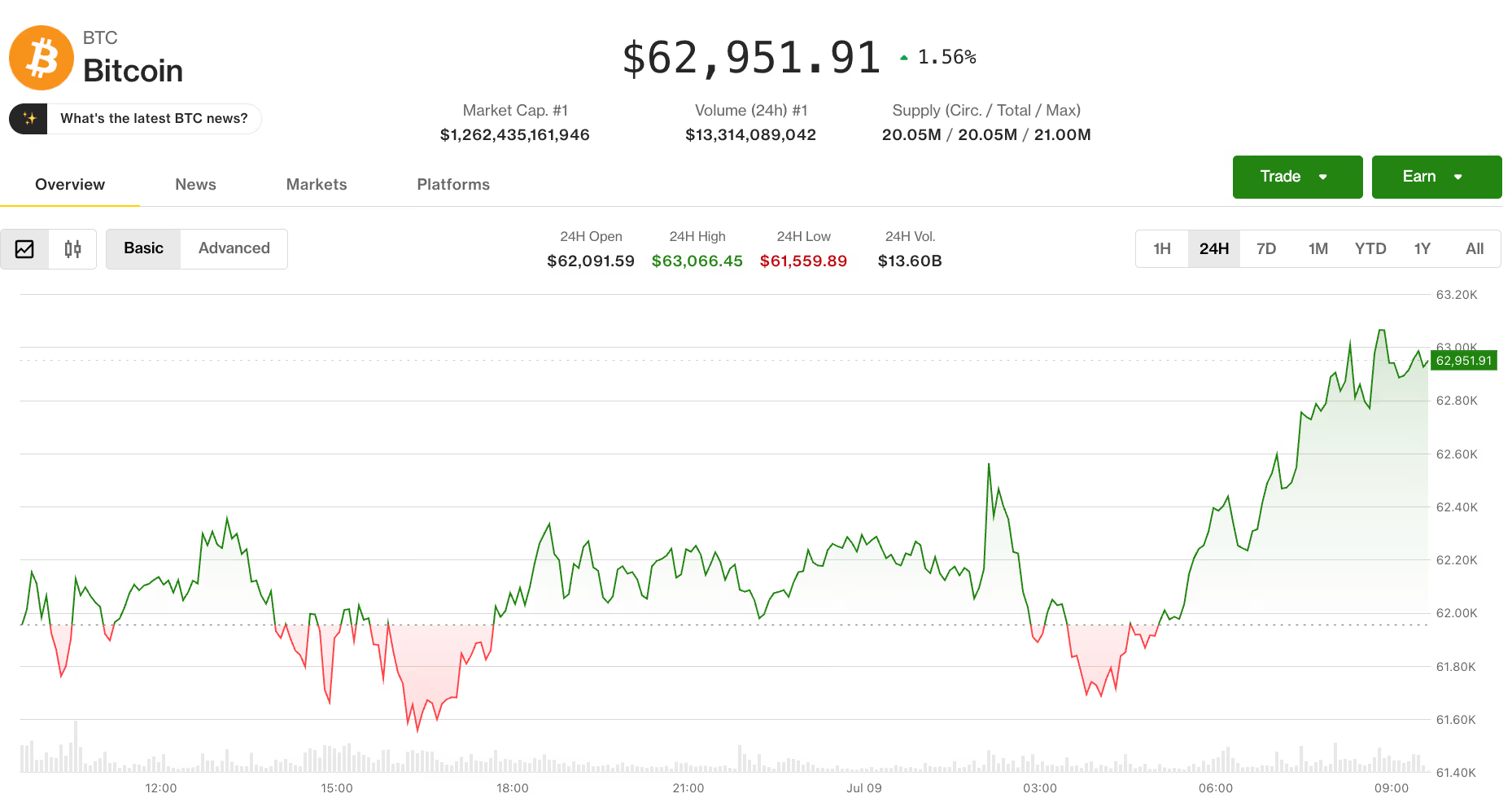
The crypto market bounced back from a mid-week lull on Thursday, with bitcoin BTC$63,186.50 rising by 1.2% since midnight UTC to $63,000 while ether (ETH) advanced 0.75% to $1,755.

The move tracked U.S. stock market gains, as Nasdaq 100 index futures added 2.6% over the past 24 hours despite the escalation of tensions between the U.S. and Iran.

U.S. Central Command said it hit 90 military targets in the latest round of airstrikes, which took place 24 hours after President Donald Trump said the ceasefire was over.

Markets initially sold off at the time, but crypto remained resilient, rallying from oversold territory to extend a relatively hot streak since the turn of the month.

Bitcoin is now 9% higher than June’s monthly close and a selection of altcoins has continued to outperform with lighter (LIT) and ether.fi (ETHFI) surging by around 35% over the same period.

Derivatives positioning

  • The crypto futures market is taking a breather, with 24-hour volume dropping almost 20% at $191 billion and open interest (OI) steady near $106 billion.
  • Bitcoin’s overnight recovery to nearly $63,000 is accompanied by a decline in open interest in major dollar and USDT-denominated futures to 266K BTC from 272K BTC. These diverging trends shows investor reluctance to take leveraged bets in such a volatile macroeconomic environment. The same is true for ether, XRP and solana.
  • OI in Canton Network’s CC token futures increased for a third straight day, with the tally rising to 271 million tokens, the most since May 31. The token continues to slide and, as noted yesterday, the concurrent increase in futures OI points to an influx of short positions or bearish bets.
  • Activity in perpetual futures tracking the S&P 500 index is again picking up, with OI increasing to the highest since SpaceX debuted on Nasdaq nearly a month ago.
  • BTC and ETH’s 30-day implied volatility indexes are back under pressure, snapping a two-day winning streak in a sign of renewed supply of options and expectations for market calm.
  • On Deribit, BTC and ETH puts remain pricier than calls across all time frames, reflecting downside concerns. The sentiment on Wall Street is the polar opposite: The average skew in S&P 500 stock options shows a record bias for calls, or bullish bets.

Token talk

  • LIT and ETHFI led gains on Thursday, rising by 5.6% and 8.5%, respectively, since midnight UTC to extend rallies that began last week.
  • Ethena (ENA) also showed signs of strength, having increased by 5.6% since Wednesday’s low. It’s worth noting that ENA has lost more than 91% of its value since September 2025 as investors deserted the yield-generating DeFi platform.
  • Another token that has struggled during this year’s bear market has been the Donald Trump family-linked WLFI, which slipped a further 0.5% on Thursday despite the market-wide recovery. Like ENA, it is down by around 90% from its record high.
  • CoinMarketCap’s Altcoin Season indicator ticked one point higher to 47/100 on Thursday, likely due to outperformance among DeFi tokens. It remains sticky at this level as investors continue to show caution until the crypto majors make a meaningful recovery.

(0)
AI contracts, not bitcoin, now drive miner valuations, and Cipher and TeraWulf look cheap, says analyst

Several companies transforming former bitcoin mining sites into AI data centers may be worth more than their current market valuations imply because investors are underestimating the value of their signed customer contracts, according to a report from Compass Point.

Analysts Michael Donovan and Ed Engel developed a framework that separates the value of long-term AI leases already under contract from projects that have yet to secure customers. They argue these companies should increasingly be valued like landlords that generate rental income rather than traditional bitcoin miners whose earnings depend on cryptocurrency prices.

To do that, Compass Point estimates the value of future rental income from signed contracts after accounting for the remaining cost of building each facility. It then compares that figure with each company’s enterprise value to estimate how much, if any, investors are paying for future development projects.

Using that approach, the firm said Applied Digital (APLD), TeraWulf (WULF) and Cipher Mining (CIFR) appear to offer the largest disconnect between their contracted business and current valuations. In each case, Compass Point argues the market is assigning little, if any, value to additional AI capacity that has yet to be leased, despite the potential for those projects to generate significant rental income once completed.

Core Scientific (CORZ) and Riot Platforms (RIOT) stand out for different reasons. Compass Point said Core Scientific’s existing contracts are already largely reflected in its valuation, meaning further upside will likely depend on signing new customers. Riot, meanwhile, is valued more on future potential than current lease income, with investors placing a premium on its Corsicana campus and broader AI development pipeline despite its relatively limited contracted capacity today.

The report argues the next two years will be a turning point for the sector as companies shift from announcing AI infrastructure deals to delivering them. As projects are completed, tenants move in and rent payments begin, investors will have a clearer picture of the recurring cash flow these facilities can generate. Companies that execute successfully could be rewarded with valuations more in line with other income-producing infrastructure assets.

The sector has already become one of the market’s strongest AI-related trades. Over the past year, shares of several former bitcoin miners have climbed sharply as they unveiled partnerships with hyperscalers and AI companies looking for large amounts of power and computing capacity. Still, returns have varied as investors weighed construction timelines, financing requirements and the pace of customer signings.

The broader shift reflects how many mining companies are repurposing sites with abundant power and existing electrical infrastructure for AI and high-performance computing workloads. Unlike bitcoin mining, where revenue can swing with cryptocurrency prices, long-term leases with investment-grade customers offer the prospect of steadier, more predictable cash flow.

Following recent pullbacks in the group, Compass Point said the market may be entering a new phase where execution matters more than announcements. As facilities come online and signed contracts begin producing revenue, the firm expects investors to focus less on future potential and more on the cash flow those projects deliver.

(0)
Validators embrace XRP Ledger’s recent upgrade. But not everyone’s on board yet

The XRP Ledger’s recent server software upgrade, v3.2.0, designed to make the network cheaper to run, more stable, and more attractive for institutional use, is gaining adoption. However, it has yet to overtake the previous version (3.1.3) across the wider network, and the key security fixes that come with it remain in the voting process.

Of the approximately 833 active nodes on the XRP Ledger, the machines that store and relay the ledger, about 43% are running v3.2.0 and 51% are still on v3.1.3, XRPSCAN data shows.

The software rolled out on June 15.

(XRPScan)

While overall node adoption appears relatively slow, validators, or entities that matter most to the network, have largely already upgraded.

The XRP Ledger runs on a trusted set of validators known as the Unique Node List (UNL). For a new software version or amendment to activate, it needs sustained support from more than 80% of validators on that list for two straight weeks.

On the default UNL of 35 validators, 31 are running v3.2.0, about 89%, clearing the threshold the network treats as sufficiently updated. That figure, not the raw node or all-validator percentages, is what determines whether the upgrade completes.

The amendment lagging behind

An amendment called fixCleanup3_2_0 is currently under voting. Unlike a regular software upgrade, this is a formal on-ledger vote. It bundles several security fixes and improvements for the network’s newer features, including single-asset vaults, permissioned decentralized exchanges, multi-purpose tokens (MPTs) and the lending protocol. The lending protocol is the on-chain lending system CoinDesk covered last month that lets users take out loans against pooled funds.

It also adds internal checks designed to prevent deleted accounts from leaving behind stray data. That amendment is polling far lower than the software adoption, however, so upgrading a validator and voting the amendment through are two distinct steps.

Ripple, the payments company whose founders created the XRP Ledger, has voted in favor of the fixCleanup3_2_0 amendment. Validators that fail to upgrade before the amendment activates risk being cut off from the ledger in what the ledger calls an amendment-blocked state.

(0)
Ethereum’s newest nonprofit wants to become Wall Street’s guide to crypto

Ethereum’s newest nonprofit is positioning itself asWall Street’s crypto sherpa, guiding banks and asset managers through the Ethereum ecosystem at a pivotal moment for the network.

For much of the past year, the conversation around Ethereum has been dominated by questions about its future. The Ethereum Foundation has faced mounting criticism over its role in the ecosystem, and, in response, has restructured its leadershiplaid off staff and narrowed its focus to stewarding the protocol. At the same time, independent organizations have begun emerging to take on responsibilities that were once housed within the foundation.

The latest is Ethereum Institutional, a nonprofit launched last week with an ambitious goal: becoming the Ethereum ecosystem’s front door for banks, asset managers and other financial institutions.

Its founders say the organization will serve as a neutral guide for enterprises exploring Ethereum, helping institutions understand the ecosystem, connect with developers and infrastructure providers, and navigate the network without promoting any single company or product.

Ethereum Institutional is led by David Walsh, Matthew Dawson and Marius Smith, whose backgrounds span traditional finance, technology and crypto. Walsh and Dawson previously worked on the Ethereum Foundation’s enterprise engagement team, while Smith joined after senior roles at Google and EigenLayer developer Eigen Labs.

“We’ve built up around 500 relationships over the course of the year, and what’s consistently come back was that they appreciate having a neutral counterpart,” Dawson told CoinDesk in an interview. “There’s thousands of teams in the Ethereum ecosystem… the feedback sometimes has been, ‘This is overwhelming.'”

The organization is designed to fill what its founders see as a missing piece in Ethereum’s institutional strategy.

Unlike companies building products on Ethereum, Ethereum Institutional says it will work across the ecosystem, helping enterprises evaluate use cases such as tokenization, stablecoins and digital asset infrastructure while introducing them to the teams best suited for their needs.

“Navigating what is already a new and fairly complex technology and the decentralized ecosystem is a bit daunting,” Dawson said. “Having a trusted and neutral partner that can help with that navigation… can accelerate that journey and give them confidence.”

Its launch comes as Ethereum itself reaches an inflection point. The leaders steering the network are increasingly formalizing how different parts of the ecosystem are taking on responsibilities and roles. The Ethereum Foundation has made clear it intends to focus more narrowly on protocol development while encouraging independent organizations to lead areas such as business development, ecosystem growth and institutional engagement.

For Ethereum Institutional’s founders, becoming an independent nonprofit rather than remaining within the foundation was a deliberate choice.

(0)
Bitcoin drops after a run at $64,000, shrugging off Strategy’s $213 million BTC sale

Bitcoin held in the low $63,000s on Tuesday after an overnight push above $64,000 faded, a round trip that left the token roughly flat on the day but still up about 6% over the week.

Bitcoin traded around $63,170, per CoinDesk data, after touching $64,400 in the early hours and slipping back. The move came despite Strategy’s disclosure this week that it sold 3,588 bitcoin for about $216 million, its largest sale since abandoning its never-sell stance, which the market largely absorbed without breaking the recovery.

Ether held near $1,770, up 11.6% on the week, while XRP and solana kept most of their weekly gains at $1.13 and $80. Most majors were little changed on the day after leading the prior week’s advance.

The recovery has firmed even as its footing stays thin. Bitcoin fell to a 21-month low near $58,000 at the end of June and has clawed back into the low $60,000s, a bounce rather than a breakdown after a first half it closed down about 20%, with its first weekly close below the 200-week moving average, a long-term trend line, since 2023.

Some derivatives traders read the washout as late-stage rather than early.

“The institutional bid has all but vanished,” said Yusuf Fakhro, partner at ARP Digital, pointing to CME futures open interest at a 32-month low and a term structure at its tightest since early 2023.

He added that six-month options skew, a measure of how much traders pay to protect against a drop, has spiked to its fourth-highest on record, with the only parallels in June and November 2022, both of which came near major cycle bottoms.

When downside insurance gets this expensive, he said, the market is paying up for protection just as the worst may already be priced in.

Oil re-entered the picture overnight. Brent crude rose 0.6% to about $72.45 a barrel after a laden liquefied natural gas carrier was struck by a projectile near the Omani coast as it left the Strait of Hormuz, according to Bloomberg, a fresh attack that tests the peace deal reached in late June.

Energy shocks tied to the Iran conflict drove crypto’s selling earlier this year before the truce eased them, and a renewed flare-up is the kind of macro risk that had faded from the market’s view.

Elsewhere, Asian shares fell as technology stocks came under renewed selling, with South Korea’s Kospi down 6.7%, according to Bloomberg. Samsung Electronics slid 8.3% even after quarterly profit surged, and SK Hynix fell the same as it began marketing a U.S. listing. U.S. futures pointed lower, suggesting Monday’s Wall Street rebound may not carry.

For most of the year, weakness in AI and chip stocks pulled crypto markets down with it, and this week the two have moved apart, with bitcoin steady as equities slid.

Whether that independence lasts, and whether the ETF inflows build, will decide if the bounce off $58,000 becomes a base or fades. The renewed oil risk out of Hormuz is the new variable – a reminder that the macro backdrop that battered crypto in the first half has not fully cleared.

(0)
Bitcoin’s dwindling exchange reserves don’t pack the same bullish punch anymore

One of bitcoin’s BTC$62,985.21 oldest and most enduring bullish signals is still making the rounds on social media even though it no longer carries the weight it once did.

For years, interpreting the amount of BTC held in wallets controlled by centralized exchanges has been straightforward. A declining balance means investors are withdrawing coins to self-custody. Fewer coins available for sale on exchanges should, in theory, reduce selling pressure and support prices. This read has been treated as reliably bullish since bitcoin’s early days and the narrative persists today, according to blockchain analytics firm Santiment.

“Historically, sustained drawdowns in exchange supply have preceded multi-quarter bull phases.” Mark Zalan, the CEO of GoMining, the world’s largest tokenized retail mining platform, said in an interview. He declined, however, to put a date on when the bull cycle will begin. “Anyone who tells a journalist they know the exact turn is guessing with confidence, not forecasting.”

The metric, however, no longer carries the weight that it used to, not least because supply has been low for months even as bitcoin has languished at around 50% of its peak value. The interpretation is outdated, some industry observers say, because it does not account for the rise in institutional custody. The financialization of bitcoin through alternative investment vehicles has changed the market in ways that make the indicator unreliable.

“People always used to look at low exchange supply as a clear bullish sign,” said Eneko Knorr, CEO of Stabolut, a multicurrency, yield-bearing stablecoin platform. “We’ve had this super-low supply for over a year now. The market grew up, and a lot of that crypto just moved somewhere else – like staking, DeFi protocols to earn some yield, or big institutional vaults.”

Santiment noted on X that the supply of BTC and ether (ETH) on exchanges has dropped to the lowest since 2017 and 2015, respectively, calling it one of the crypto’s “most encouraging signals for the long term.” According to Santiment’s chart, bitcoin’s exchange supply sits at 6.6% of its total circulating supply and ether’s at 4.3%.

“Bitcoin and ethereum are showing one of crypto’s most encouraging signals for the long term: coins are staying off exchanges,” Santiment said. “That means fewer coins are immediately available to sell, even after months of volatility.”

Because bitcoin and ether still dominate the crypto market, low supply at exchanges can help set up the next “sustained bull cycle,” the company said, though it cautioned the market is not there yet. The combined market capitalization of the two largest cryptocurrencies accounts for almost 66% of the total market, according to CoinGecko data.

(0)